
How Your Home AC System Works
An air conditioner does not create cold. It moves heat from inside your home to the outdoors, using refrigerant as the carrier and two coils as the transfer points. Once that clicks, symptoms become much easier to interpret.
- 24/7 emergency availability
- Killeen & nearby communities
- 254-252-3503
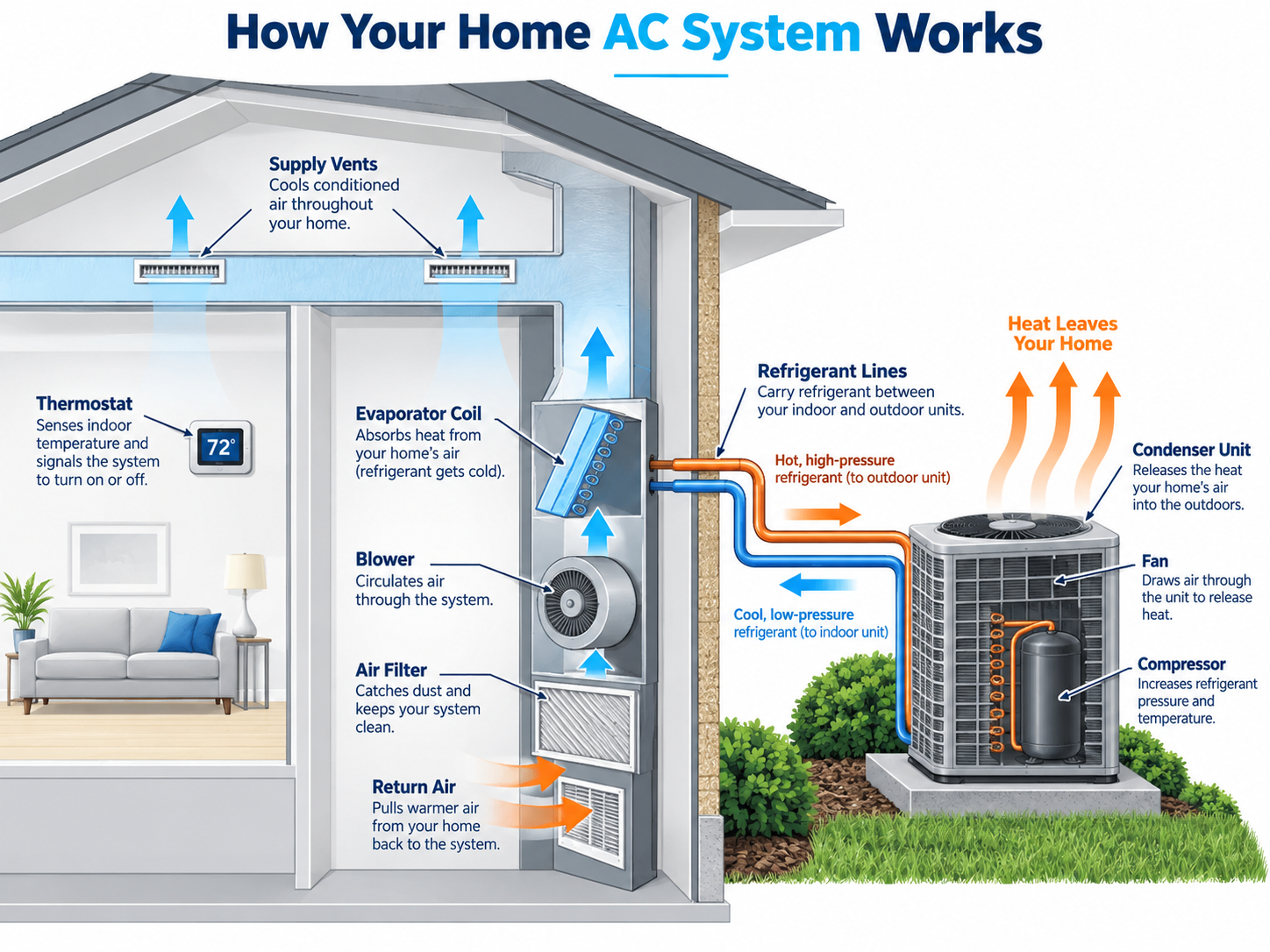
The cooling loop, step by step
- Thermostat: senses indoor temperature and signals the system to start or stop.
- Return air: warm indoor air is pulled back to the system through return grilles and ductwork.
- Air filter: catches dust before it reaches the coil and blower, protecting airflow.
- Blower: moves air across the evaporator coil and pushes it back out through the supply ducts.
- Evaporator coil: cold refrigerant inside absorbs heat and moisture from the passing air.
- Refrigerant lines: carry cool low-pressure refrigerant to the outdoor unit and hot high-pressure refrigerant back.
- Compressor: raises refrigerant pressure and temperature so it can release heat outdoors.
- Condenser coil and fan: the outdoor fan pulls air across the coil so heat leaves your home.
- Supply air: conditioned, dehumidified air returns to your rooms through the vents.
Why moisture removal matters as much as temperature
As indoor air passes across the cold coil, water condenses out of it and drains away. That is why comfort depends on runtime, not just setpoint: a system that satisfies the thermostat in short bursts removes less moisture, and a 74-degree house with high humidity feels worse than a 76-degree house that is properly dehumidified.
It is also why a condensate drain is not an accessory — it is handling gallons of water on a humid Central Texas afternoon.
How this maps to the symptoms you see
- Weak airflow at vents: filter, blower, ducts or a coil that is icing.
- Air not cold: refrigerant side, compressor performance or heat rejection outdoors.
- Outdoor unit silent: electrical start components, fan motor, compressor or power.
- Water indoors: condensate drainage or a thawing coil.
- Ice on lines: restriction or low charge.
- Short cycling: controls, airflow, refrigerant or oversizing.
Why the outdoor unit struggles more in Killeen summers
Heat rejection depends on the difference between the refrigerant temperature and the outdoor air temperature. When it is 100 degrees outside, that difference shrinks, so the system needs a clean coil and unrestricted airflow to keep working effectively. That is exactly why a coil packed with dust or grass clippings turns into a real capacity problem here rather than a minor maintenance note.
Frequently asked questions
Does an air conditioner bring in outside air?
A standard residential system recirculates indoor air. It exchanges heat with the outdoors through the refrigerant loop rather than moving outdoor air into the home.
Why does my AC drain water?
Because it removes humidity from indoor air. That condensate collects in a pan and drains away, and blocked drainage is a common source of indoor water problems.
What does the compressor actually do?
It raises the pressure and temperature of the refrigerant so heat collected indoors can be released to the outdoor air.
Is a heat pump different?
In cooling it works the same way. A heat pump adds a reversing valve so the cycle can run in the opposite direction to heat the home in winter.
AC Not Cooling in Killeen?
Call any time, day or night, to talk through what your air conditioner is doing and request service.