
Why Is My AC Not Cooling? A Step-by-Step Explanation
If your air conditioner is running and the house is not getting cooler, the system has stopped moving heat out of your home at the rate it needs to. This page walks through why that happens, in the order a technician would think about it.
- 24/7 emergency availability
- Killeen & nearby communities
- 254-252-3503
1. Is the system actually calling for cooling?
Start at the control. Confirm the thermostat is in cool mode with a setpoint below room temperature and the fan set to auto. Check batteries. If the display is blank, the cause is often upstream — a tripped condensate float switch, a blown low-voltage fuse or a transformer problem.
2. Is enough air moving?
Cooling requires airflow across the indoor coil. Hold your hand at a supply register: is the air cool but weak, or is there plenty of air that simply is not cold?
- Cool but weak air points to airflow: filter, blower, duct restriction or a partially frozen coil.
- Plenty of near-room-temperature air points to the refrigeration side or the outdoor unit.
- Little or no air at all points to the blower, a tripped safety, or a duct disconnection.
3. Is the outdoor unit running?
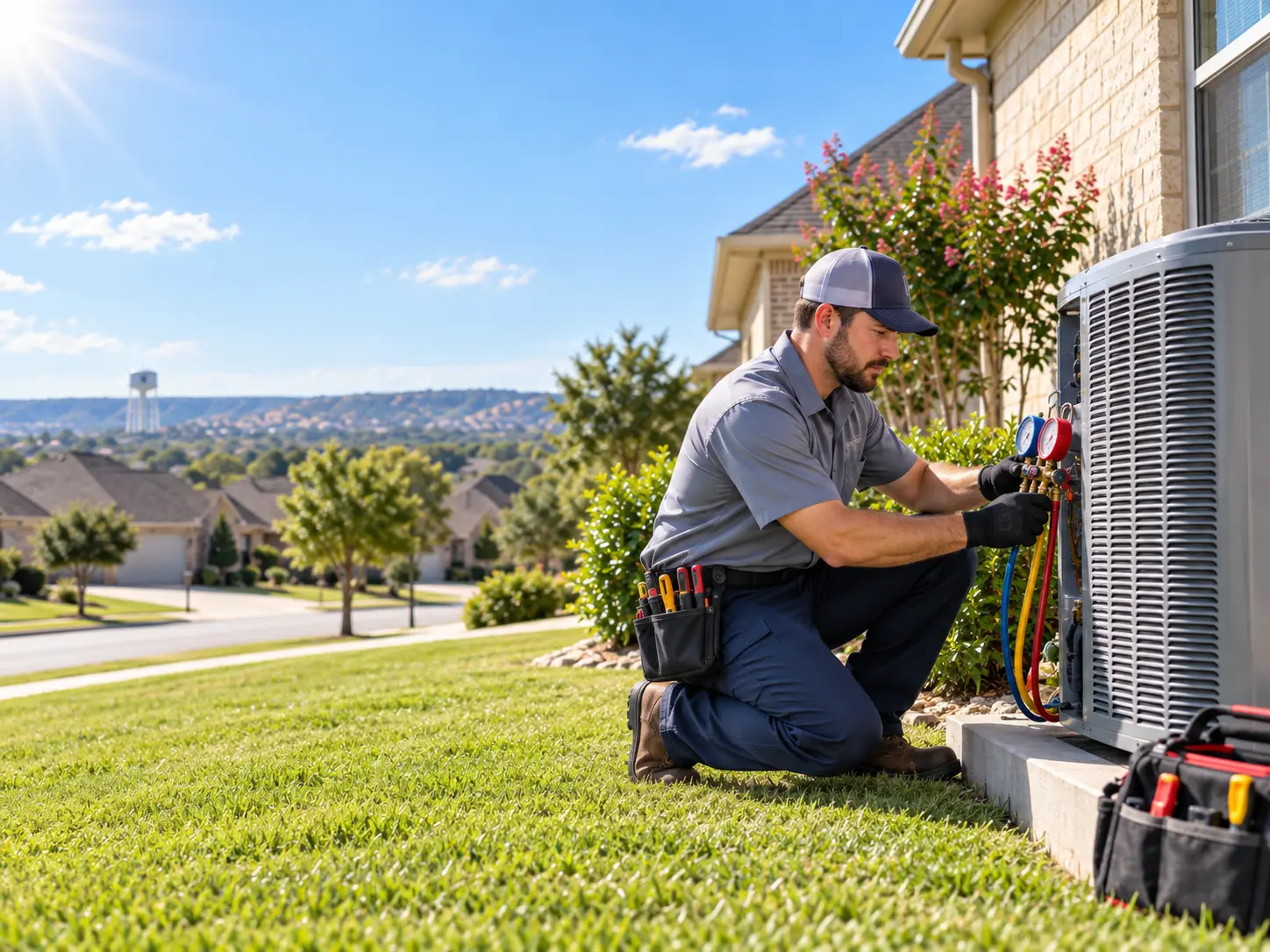
Walk outside. If the fan is not spinning and the compressor is silent while the indoor blower runs, the problem is almost certainly at the outdoor unit — commonly a capacitor, contactor, fan motor or compressor issue, or a breaker or disconnect that is off.
If the fan is spinning and the unit is running but the discharge air off the coil feels only slightly warm, heat is not being rejected properly, which points to a dirty coil, low charge or a compressor that is not pumping.
4. Is there ice anywhere?
Ice on the suction line or indoor coil means the coil is running colder than the passing airflow can support — usually from restriction or low charge. Ice then blocks airflow, which makes cooling collapse. Turn cooling off, set the fan to on, and let it thaw before running again.
5. Is the house losing the battle instead of the system failing?
Sometimes the equipment works but cannot keep up. In Killeen, that shows up as a system that holds setpoint in the morning and drifts upward after 3 p.m. Duct leakage in a hot attic, dirty coils, low airflow, high solar gain and very low setpoints all contribute. This is where measurements — temperature split, static pressure and refrigerant readings — tell you whether it is a capacity problem, a distribution problem or a failing component.
Safe checks summary
- Thermostat mode, setpoint, batteries.
- Filter condition, if accessible.
- Registers open, returns unblocked.
- Breaker status — one reset only.
- Outdoor unit running, coil clear of debris and vegetation.
- Ice or water present.
- Never open high-voltage panels, touch capacitors or handle refrigerant.
Frequently asked questions
Why is my AC blowing warm air?
Most often the outdoor unit is not operating, the refrigerant charge is low, or on a heat pump the system is in the wrong mode. Confirm the thermostat setting, then check whether the outdoor unit runs.
Can low refrigerant fix itself?
No. Refrigerant does not get consumed, so a low charge means a leak that should be located and repaired.
How long should it take to cool the house down?
It varies with the outdoor temperature, insulation and how far the indoor temperature has risen. On extremely hot afternoons, recovery from a high indoor temperature can take hours even on a healthy system.
Should I turn the system off while I wait for service?
If it is frozen, leaking water or making unusual noises, turning it off is generally the safer choice. If it is running normally but underperforming, running the fan can still help circulate air.
AC Not Cooling in Killeen?
Call any time, day or night, to talk through what your air conditioner is doing and request service.